Revenge Trading Saved My Day, and That Is the Problem (Ep. 4)
Revenge trading on my prop firm account: +$838 on September 28, but only 2 of my 5 rules held and the winning trade risked 73% of all my remaining room.
Tonight, $5,878 separates my account from the $282,000 floor: the balance is $287,878, and the room grew by $690 over two sessions. On paper, that is good news. In detail, September 28 is the day I would least like to repeat: revenge trading saved it, only 2 of my 5 rules held, and the trade that rescued the day was the most dangerous one.
This is episode 4 of my $300,000 prop firm account journal. Below you will see the day trade by trade, why the winning trade risked 73% of my room, an honest review of my trading rules, what the gold backtests showed, the paper trading results, and the question left open in episode 2: keep going or pause.
Key facts
- On the evening of September 28, the account is at $287,878: $5,878 above the $282,000 floor, versus $5,188 in episode 2 (+$690 over two sessions).
- The day ends at +$838, with 5 losses and one +$3,032 win. Every trade was a short, in the direction of gold's decline.
- The winning trade risked $2,072, or 73% of the $2,846 of room I had left. Had it been stopped out, the account would have ended $774 from closure.
- Trading rules: 2 out of 5 held, plus one halfway. The 2-losses-per-day rule and the $375 maximum risk both broke.
- Gold backtests: none of the methods tested is profitable. A result that looked exceptional over 5.5 years came from a simulation error.
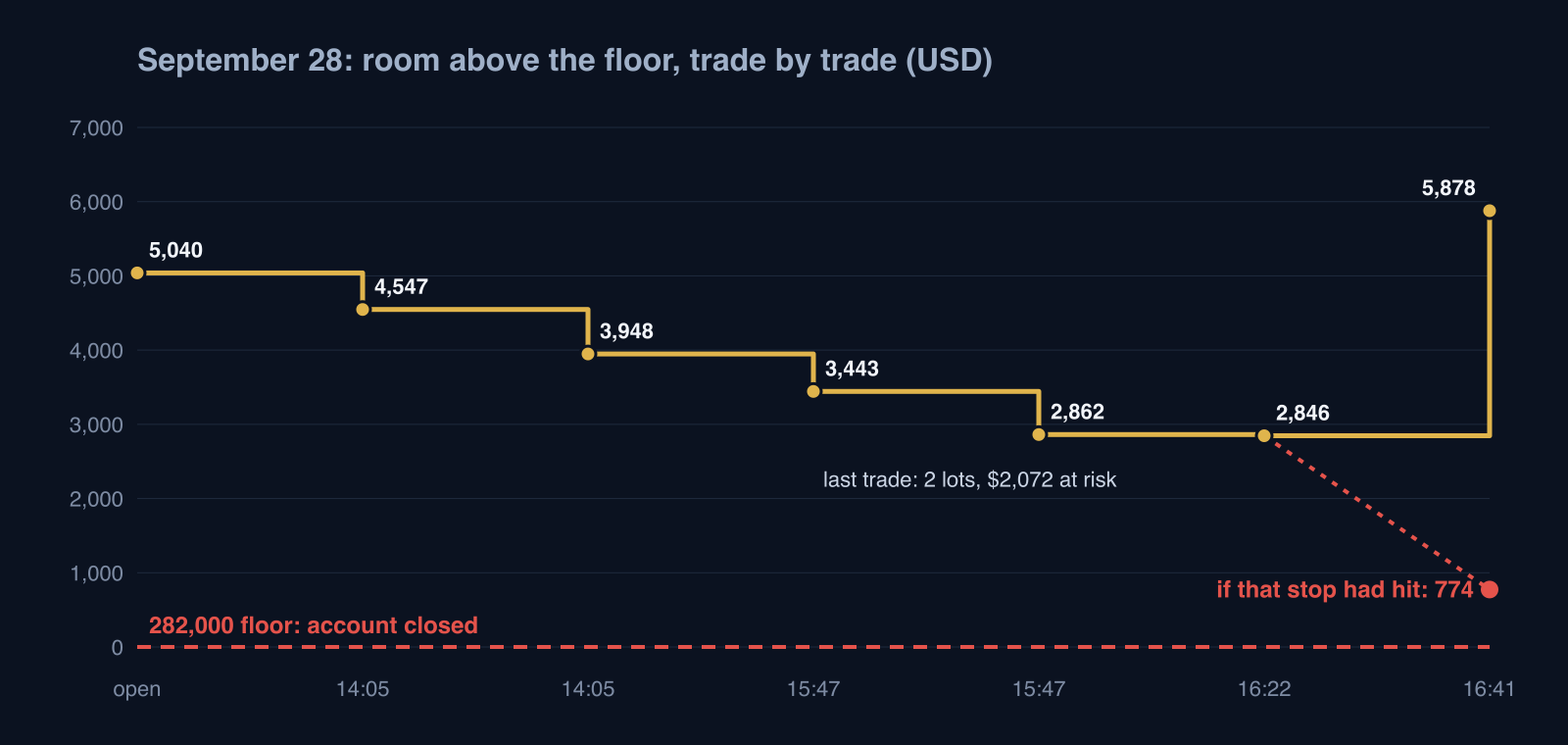
Room above the $282,000 floor after each close on September 28. Dotted red line: what would have happened if the last trade had hit its stop.
The number: $5,878 above the floor
The account is at $287,878 tonight, which leaves $5,878 of room before closure. On September 24, in episode 2, it was $5,188. Since then:
- September 25: −$148. Episode 3 showed −$144; a last 0.01 lot trade cost another $4.
- September 28: +$838.
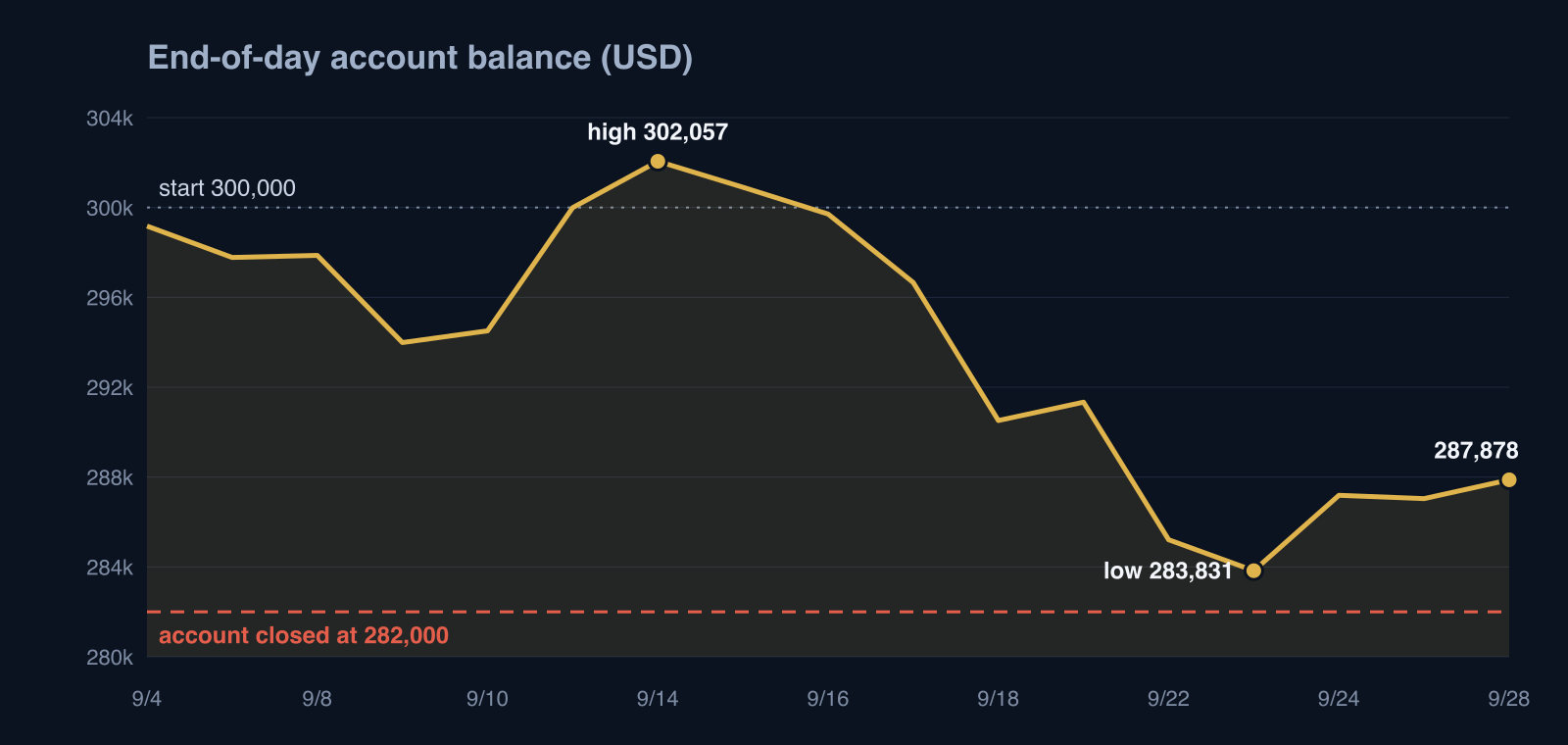
The room grew by $690 over two sessions. But how it grew matters more than the number.
My September 28, trade by trade
Every trade was a short, in the right direction: the problem was not direction. Gold fell all day, from about $4,269 at the open to $4,114 at the close, roughly −$155. Since the September 18 peak ($4,399), it has dropped more than $280. There was no major economic release that day: it was a decline without news.
| Time | Trade | Entry | Stop | Exit | Result |
|---|---|---|---|---|---|
| 13:55 | short 0.5 lot | 4,151.14 | 4,161, set with the order | stopped at 14:05 | −$493 |
| 14:00 | short 0.5 lot | 4,148.67 | set after the order | stopped at 14:05 | −$599 |
| 14:55 | short 1 lot | 4,150.16 | set after the order | stopped at 15:47 | −$505 |
| 15:41 | short 0.5 lot | 4,145.60 | set after the order | stopped at 15:47 | −$581 |
| 16:08 | short 2 lots | 4,142.64 | moved to break-even | exit at 16:22 | −$16 |
| 16:24 | short 2 lots | 4,141.64 | 4,152, set with the order | target 4,126.48 at 16:41 | +$3,032 |
| Total | 5 losses, 1 win | +$838 |
At 14:05 I had 2 losses. My rule no. 2 says: done for the day, platform closed. I did not close it. The 15:41 short was taken while the 14:55 one was still open, and on the last trade I moved the target lower along the way.
September 25, same script
September 25 followed the same pattern: big losses early, then recovered by increasing exposure. Day total: −$148.
- Long 1 lot at 15:17, stopped at 15:30: −$1,929.
- Long 1 lot at 15:39, stopped at 16:01: −$1,083.
- A near-flat trade: +$4.
- Two longs held together (0.5 lot at 16:38, 1 lot at 17:47), closed at 18:02: +$1,056 and +$1,808.
- 0.01 lot: −$4.
The trade that saved the day was the most dangerous
The winning trade at 16:24 risked 73% of my remaining room. Just before it, after 5 losses, I had only $2,846 left above the floor. It risked $10.36 × 2 lots, or $2,072. Had it hit its stop, the account would have ended the day $774 from permanent closure.
It complies with the firm's rules: the 1% per-trade cap is $3,000. It is far from mine: I had set a $375 maximum in episode 2. It won. That does not make it a good decision.
This is exactly the revenge trading pattern I described in episode 1: doubling size after a string of losses to "make it back". It worked twice in a row, on the 25th and the 28th. That is what makes it dangerous.
My trading rules: an honest review, rule by rule
Of the 5 rules in my trading plan, 2 held and one held halfway. Here are the details, without dressing up the numbers.
| Rule | Verdict | What happened |
|---|---|---|
| 1. Maximum risk of $375 per trade while the room is under $5,000 | broken | After the 1st loss the room fell below $5,000; every later loss is above $490, and the last trade risked $2,072 |
| 2. 2 losses = done for the day | broken | I kept going after the 2nd loss at 14:05 and took 4 more trades |
| 3. No trades within 10 minutes of a "High" release | kept | No release of that level that day |
| 4. Stop set before submitting the order | halfway: 2 times out of 6 | The other 4 stops were set after the order, within the firm's 5-minute window but not within my rule |
| 5. Publish the room every week | kept | This article |
Rule no. 3 held because no release fell that day, not because of any effort on my part. The two rules that really mattered, position size and stopping after 2 losses, are the ones I broke. Writing rules down is still not enough.
Gold backtests: what the tests showed
None of the ways I tested to trade my gold zones makes money. I use buy and sell zones computed automatically by three engines, a fixed-rules program and two AI assistants (my Jev vs Claude vs Python comparison introduces them). Today I asked them a simple question: is there a way to trade these zones that makes money? The tests cover 3 months, then 5.5 years of minute-by-minute history.
- Buying or selling the bounce off the zone: 648 settings tested, none profitable. You can get 84% winning trades (small target, big stop), but you still lose: each stop wipes out 5 to 10 wins.
- Very short stop ($1 to $5) with a distant target: 360 settings, none profitable. With a $1 stop, price hits the stop 63% of the time, and the spread alone eats 30% of the risk.
- Trading the zone breakout: over 3 months, it looked profitable. Over 5.5 years it even looked exceptional, with every year a winner. Too good.
I looked for the error and found it: the test sold at the edge of the zone when price had already moved below it. In real trading you get filled lower. Once corrected, every year is a loser, from 2021 to 2026.
The most useful lesson of the day: a backtest that looks perfect almost always contains an error. This is the sixth time I have run into this kind of false result. I also switched off the more expensive of the two AI assistants, about $3.80 per market day, for zones that do not win more than the others.
Paper trading and tracked signals
In paper trading, the previous-day high/low breakout scored its first win after 3 losses. Short at 4,227.38 at 3 a.m., after the break of Friday's low, held all day and closed at the end of the session around 4,114: about +$4,635, or +3.1 times the risk. Running total: 4 trades, 1 winner, about +$1,400 (+0.9 R).
The TRADE CRAFT signal channel, which I track on paper with my own position size, went short at 4,154.64 at 14:59, target hit at 15:02: +$1,754. Running total: 10 trades, 50% winners, −$2,681. That signal came 4 minutes after my own 14:55 short, at about the same price. Its stop was $7.36 from entry, mine $5: theirs held, mine did not.
In both cases, 4 and 10 trades prove nothing. It takes around a hundred.
Keep going or pause?
The numbers do not settle it yet, but they lean toward caution. Here is what they say, without dressing them up:
- none of the methods I tested on gold has a proven edge;
- my last two sessions followed the same script: big losses, then a recovery with bigger size;
- on September 28, one losing trade at the wrong moment would have left $774 before the account closed.
The room went up. But the way it went up is the way that already closed an account on September 2. The 100-trade mark in paper trading is still far away. In episode 5, I will say whether I kept my rules for a full week, with the numbers to check it.
FAQ
How do you stop revenge trading?
In my case, writing the rule down was not enough: on September 28 I kept trading after 2 losses when my plan said stop. The rule has to trigger on its own, with no decision to make in the moment: shut down the platform, not just the chart. That is the measure I announced and did not apply.
Why is increasing size after losses dangerous?
Because a single stop at the wrong moment can wipe everything out. On September 28, after 5 losses, my last trade risked $2,072 of $2,846 of room, or 73%. It won $3,032, but had it lost, the account would have been $774 from closure. The result does not make the decision good.
Why is a backtest that looks too good suspicious?
Because it almost always hides a simulation error. On gold, my breakout strategy looked like a winner every year over 5.5 years. The test sold at the zone edge when price had already moved below it. Once the fills were corrected, every year from 2021 to 2026 was a loser.
How many trades do you need to judge a strategy?
Around a hundred. My paper trading has 4 for the previous-day breakout (1 winner, about +0.9 R) and 10 for the tracked signal channel (50% winners, −$2,681). In both cases that is far too few to tell anything, either way.
Next episode: how to trade news, what moved gold on September 29.
All episodes of the journal are collected on the blog.
This article is not investment advice. Trading on margin carries a high risk of losing capital.
This content reflects personal experience and is not financial advice. Trading leveraged products carries a high risk of losing money.
Never get caught by a news spike again
Get every high-impact economic event in real time via API or Telegram.
See pricing