Prop Firm Challenge Journal: Saving My $300K XFunded Account
Real numbers from a $300,000 XFunded prop firm challenge: −$14,834 in 13 trading days, the account rules, my mistakes and the plan to save it. Episode 1.
Updated on September 24, 2026
On September 4, 2026, I got a $300,000 prop firm challenge account at XFunded. On September 22 it shows $285,166, down 4.9%. This series documents, with real numbers, my attempt to bring the account back before it hits the max drawdown floor.
Key facts
- $300,000 XFunded challenge opened September 4, 2026, at $285,166 on September 22 (−$14,834, −4.9%).
- Room left before the account is lost: about $3,166 if the floor is −6%, less than my worst day this month (−$6,142).
- 50 closed trades, 53% winners, still a net loss: the average loss (−$1,369) is 2.2 times the average win (+$626).
- The plan: risk cut to 0.25% per trade, stop after 2 losses, no strategy touches the live account without proof in paper trading.
- 20,000-scenario simulation: 10 to 18 weeks to get back to $300,000, with a 35% to 76% chance depending on the real drawdown room.
Starting point: −$14,834 in 13 trading days
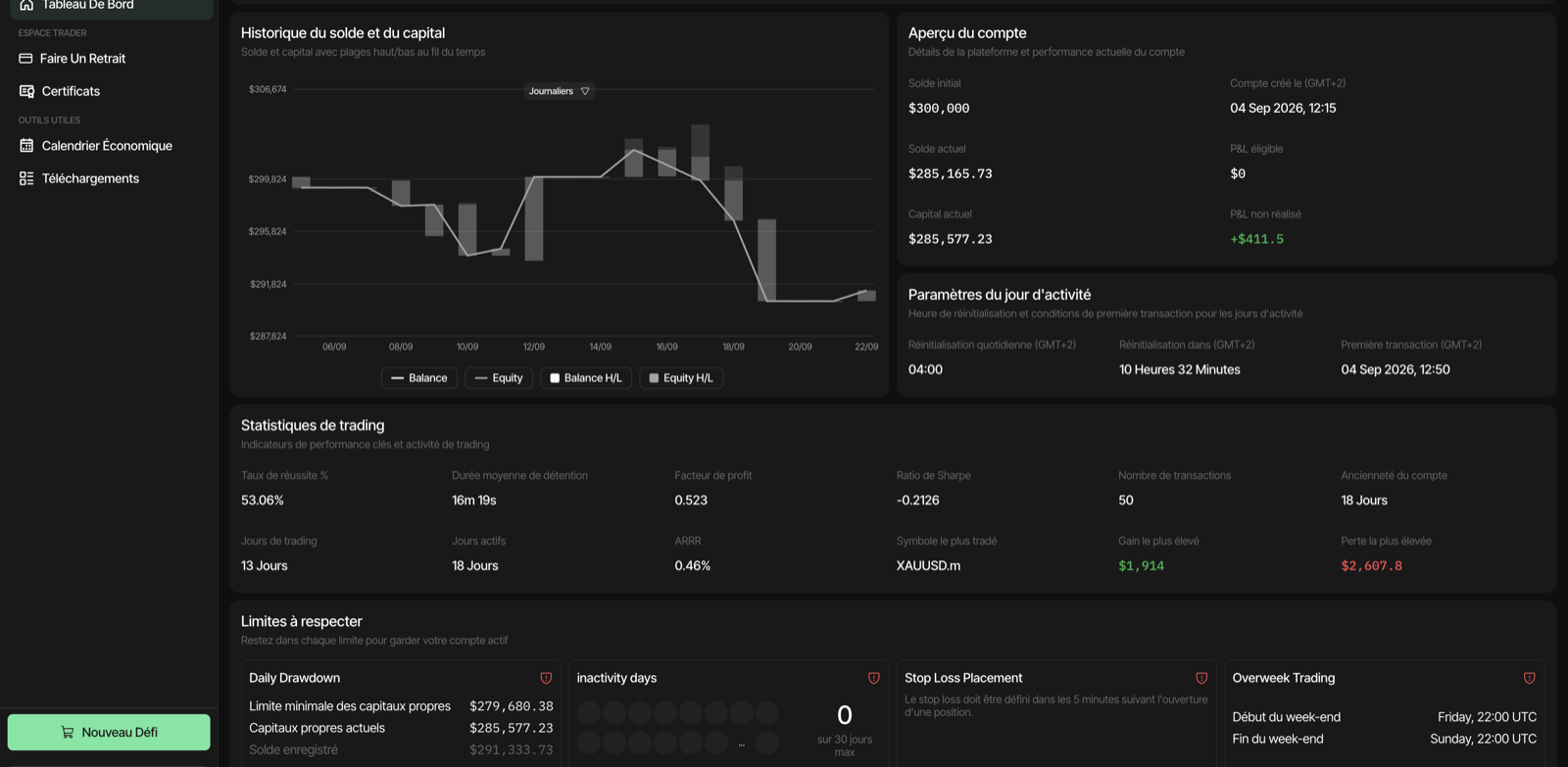
My XFunded dashboard on September 22, 2026: balance history, trading statistics and account limits.
This is not my first XFunded account. The previous one, $25,000, was closed on September 2 for a single reason: two trades had risked more than 1% of capital (−1.86% and −1.22%). The unsettling part is that the violation happened on August 19. The breach notice came two weeks later. Prop firms audit the full trade history after the fact. One position-sizing mistake can kill an account weeks down the line.
I am starting this journal to document the recovery attempt. No cherry-picked profit screenshots, no "secret strategy": raw numbers, including the bad ones.
The rules of the $300K XFunded challenge
A prop firm does not judge you on profit alone. It judges you on every limit, and one breach is enough to lose the account. Here are my account's rules as I understand them on September 22, 2026:
| Rule | Limit on my account |
|---|---|
| Risk per trade | 1% max of initial capital ($3,000) |
| Daily drawdown | 4% of the balance recorded at the 04:00 (GMT+2) daily reset. On September 22 the daily floor sits at $279,680 |
| Max drawdown | Fixed equity floor, to be confirmed on the dashboard (likely −6%, i.e. $282,000) |
| Stop loss | Mandatory, placed within 5 minutes |
| Economic news | No trading within ±10 minutes of "High" impact events |
| Weekend | No open positions from Friday 22:00 to Sunday 22:00 UTC |
| Consistency rule | Best day may not exceed 50% of total profit |
Do the math with me. If the floor really is $282,000, I have $3,166 of room left. That is less than my worst day this month (−$6,142 on September 18). I am closer to the exit than to the target.
My mistakes, unfiltered
I went through my first 48 closed trades in detail (50 as of September 22). The verdict is harsh.
54% winners, still losing money. Average win +$626, average loss −$1,369. I lose 2.2 times more when I am wrong than I make when I am right. With that ratio I would need a 69% win rate just to break even.
The XFunded dashboard confirms it: profit factor 0.52 (I make 52 cents for every dollar I lose), Sharpe ratio −0.21, average holding time 16 minutes. My single largest loss, $2,608, is 0.87% of initial capital, a hair under the 1% limit that killed my previous account.
Short take-profits, wide stops. I was locking in $3 to $5 on gold while letting price run $8 to $15 against me. The classic "gut feel" scalping trap.
Revenge trading. My three worst days (−$3,048, −$6,142, −$5,196) are all strings of trades taken right after a loss, to "make it back".
Hunting for the miracle strategy. Using analysis tools I tested more than 270 gold setups: indicators, ICT concepts, session breakouts, mean reversion, even AI models deciding the trades. None beat random reliably. One AI-driven bot returned −89% in backtest.
Trusting signal channels. I checked several Telegram signal channels trade by trade against real prices. One had no measurable edge. Another shows excellent numbers but has deleted several hundred messages from its history, so there is no way to know whether it erases its losers.
Not reading my own limits. As of today I still have not checked the exact max drawdown floor on my dashboard. That is the first thing I do this week.
My technical setup
I am not a developer by trade, but I built a full lab with an AI assistant handling most of the code and analysis:
- A Linux VPS running 24/7 with MetaTrader 5 inside a Docker container.
- Python connected to MT5 to read prices, account state and trade history.
- Minute-level historical data (Dukascopy), timestamped in true UTC, so backtests cannot cheat.
- The Forex Calendar Pro economic calendar, to stay out of forbidden news windows and to measure how news moves gold.
- Telegram alerts: every signal, entry and exit from my tests lands on my phone.
- Paper trading services: strategies running in real time on live prices with no real orders, to judge them before risking a dollar.
The rule I apply now: no strategy touches my account until it has proven something in paper trading.
How I use the Forex Calendar Pro API for economic news
Disclosure: Forex Calendar Pro is my own service. I built it because the "no trading within ±10 minutes of a High event" rule is hard to enforce by hand, and one slip is enough to lose the account.
Three concrete uses in my lab:
- Automatic lockout of forbidden windows. Every morning my Python script pulls the day's events with
GET /api/announcements?impact=high&tz=ny. Any entry within 10 minutes of a High event is rejected before it ever reaches MT5. - Measuring news impact on gold in backtests. The
/api/announcements/archive?from=…&to=…&impact=highendpoint returns historical events. I line them up with my Dukascopy minute data to see what XAU/USD actually does in the 30 minutes after an NFP or CPI print, instead of guessing. - Daily Telegram briefing. The day's High events arrive on my phone before the London open. I know exactly when I am not allowed to trade.
This is not what makes a strategy profitable. It is what keeps an average strategy from being executed by an administrative rule. The API documentation covers the parameters, and the free plan is enough for the weekly calendar.
The rescue plan
1. Stop the bleeding
- Risk cut to 0.25% per trade ($750), or 0.125% while the room is this thin.
- Never a stop loss wider than the take-profit.
- Done for the day after 2 losses.
2. Two strategies under live test
- Previous-day high/low breakout, confirmed by an H1 close. The only idea that holds up over 8 years of data: +0.105 R per trade, 8 positive years out of 9. Over the last 6 months, simulated on my account at 0.5% risk, it would have made +$20,690, but with a −$13,000 drawdown and a June that alone outweighs the total.
- One signal channel, tracked live. Every message is logged the second it arrives, before any deletion or edit.
3. Be realistic about time
I ran 20,000 scenarios. With a slight-edge strategy at 0.25% risk, getting back to $300,000 takes roughly 10 to 18 weeks. Depending on the real room before the floor, my odds range from 35% to 76%. With the way I traded before, the same simulation gives 0%. The conclusion is clear: position size is not the first thing to change. The way I trade is.
Account tracking
This table is updated with every episode.
| Date | Balance | Room before floor (if −6%) | Notes |
|---|---|---|---|
| 2026-09-04 | $300,000 | $18,000 | Account opened |
| 2026-09-22 | $285,166 | $3,166 | −4.9%, 50 trades since opening, intraday reading (close: $285,209), floor to be confirmed |
| 2026-09-23 | $283,831 | $1,831 | Lowest point |
| 2026-09-24 | $287,188 | $5,188 | Floor confirmed at $282,000 (episode 2) |
| 2026-09-25 | $287,044 | $5,044 | First day with AI Zones, −$144 (episode 3) |
FAQ
What are the rules of the $300K XFunded challenge?
On my account: 1% max risk per trade, 4% max daily drawdown, a fixed equity floor (likely −6%), mandatory stop loss within 5 minutes, no trading within ±10 minutes of High impact news, no weekend positions and a 50% consistency rule. The full table is above.
Why was my prop firm account closed two weeks after the breach?
Because prop firms audit trade history after the fact. On my $25,000 account the violation (two trades over 1% risk) happened on August 19 and the account was closed on September 2. Rule compliance is checked on every trade, not just on the final balance.
Can you recover a prop firm account that is down 4.9%?
Mathematically yes, but slowly. My 20,000-scenario simulation gives 10 to 18 weeks at 0.25% risk per trade with a slight statistical edge, and a 35% to 76% success rate depending on the real room before the floor. With my old way of trading, the probability is 0%.
What this series will cover
Every week:
- the real state of the account (balance, room before the floor, compliance with each rule);
- paper trading results for every strategy, losers included;
- what I learned, and the mistakes I still failed to avoid.
I do not know whether this account will survive. But if you trade with a prop firm, you will see from the inside what loses an account, and maybe what saves one. All episodes are collected in the journal.
Next episode: my prop firm max drawdown and the 7 rules as they actually apply.
This article is not investment advice. Trading on margin carries a high risk of losing capital.
This content reflects personal experience and is not financial advice. Trading leveraged products carries a high risk of losing money.
Never get caught by a news spike again
Get every high-impact economic event in real time via API or Telegram.
See pricing