How to Trade News: What Moved Gold on Sept. 29 (Ep. 5)
How to trade news, from a real prop firm day: the RBA hike faded, while a weak JOLTS report and US confidence lifted gold $12.90 in an hour. My account: −$364.
On Tuesday, September 29, the most anticipated release of the day, the Reserve Bank of Australia's rate hike, pushed AUD/USD up 12.9 pips in one minute. By the evening the pair was about 30 pips lower. Meanwhile, two US releases rated only "medium", the JOLTS report and consumer confidence, lifted gold $12.90 in an hour.
If you want to know how to trade news, that contrast is the lesson. Every reaction below is measured minute by minute from my own economic calendar feed. This is also episode 5 of my $300,000 prop firm journal, and episode 4 promised a verdict after a full week of rules kept. It took one day for the two-loss rule to break again. You will see the day's releases, how each market reacted, my 5 trades, and what I now do around news.
Key takeaways
- On September 29, 2026, the RBA raised its cash rate from 4.35% to 4.60%, as expected: AUD/USD gained 12.9 pips in a minute but lost about 30 pips on the day.
- At 16:00 Paris time, US consumer confidence (81.9 vs 89.2 expected) and JOLTS job openings (7.08M vs 7.23M) both came in below forecast.
- Gold rose $6 in one minute and $12.90 in one hour after those two "medium" releases, with a $17.70 range.
- My account closed at $287,514: $5,514 above the $282,000 floor, down $364 on the day across 5 trades.
- My "2 losses and I'm done" rule broke at 12:46, and none of the 5 trades stayed under my $375 risk cap.
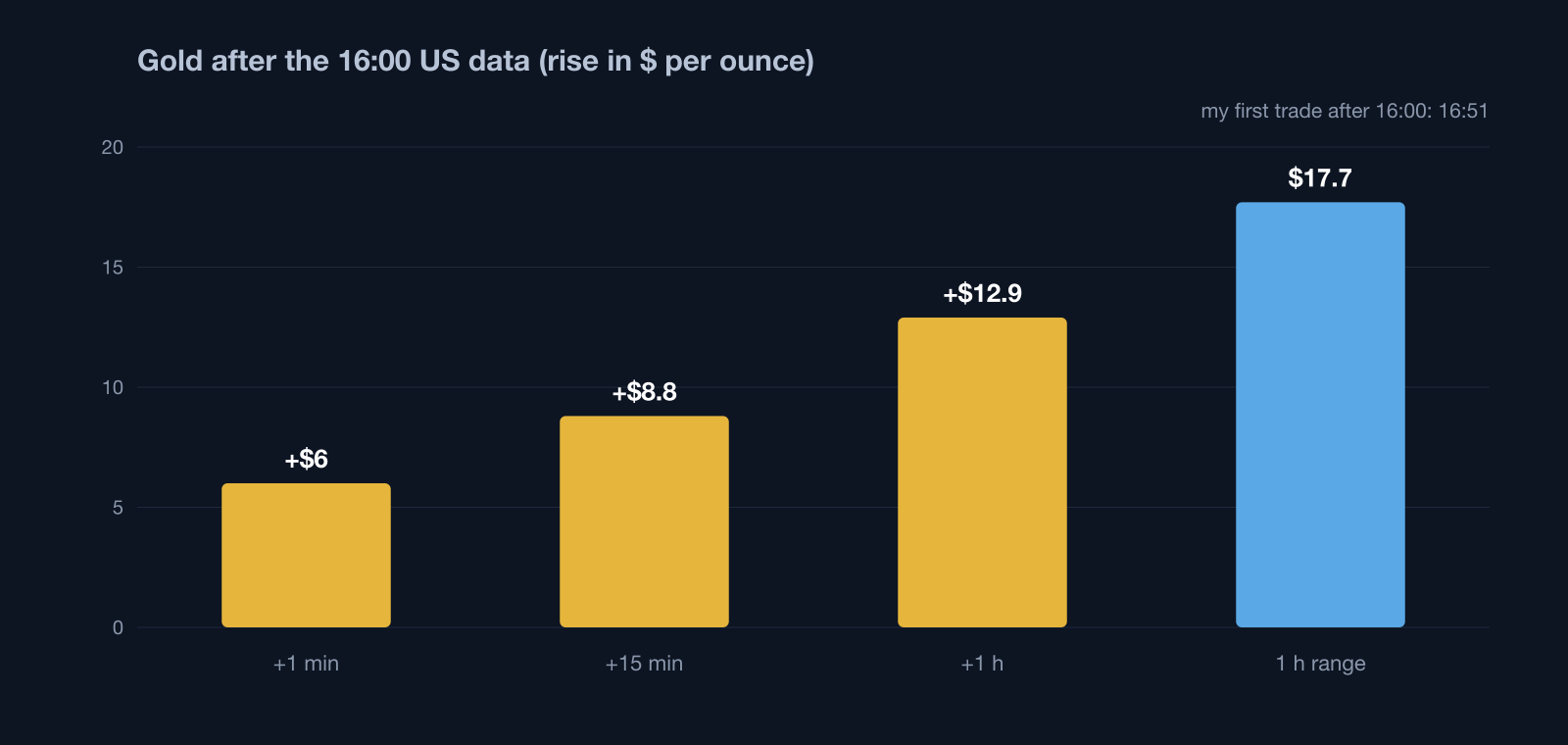
Gold after the simultaneous release of US consumer confidence and JOLTS job openings, 16:00 Paris time (10:00 a.m. New York).
The economic calendar for September 29, 2026
The calendar had two high-impact releases, both Australian, and a block of US data at 16:00. All times are Paris time.
| Time | Release | Impact | Forecast | Actual | Previous |
|---|---|---|---|---|---|
| 03:30 | Australia CPI (year over year) | High | 4.1% | missing from my feed | 3.5% |
| 06:30 | RBA cash rate decision | High | 4.60% | 4.60% | 4.35% |
| 13:00 | Christine Lagarde speech (ECB) | Medium | n/a | n/a | n/a |
| 14:30 | Canada monthly GDP | Medium | 0.0% | 0.0% | 0.4% |
| 16:00 | US consumer confidence (Conference Board) | Medium | 89.2 | 81.9 | 88.6 |
| 16:00 | US JOLTS job openings | Medium | 7.23M | 7.08M | 7.34M |
The actual Australian CPI figure is missing from my feed that day, so I cannot say whether it surprised. I only report the market reaction.
The RBA hike: an expected decision, a move that faded
A high-impact release that matches its forecast moves price for a moment without setting the direction for the day. The Reserve Bank of Australia lifted its rate from 4.35% to 4.60%, exactly as forecast. AUD/USD at 06:30:
- +12.9 pips in the first minute;
- a 23.6-pip range in the first hour;
- +11.3 pips one hour later.
Over the full day, though, AUD/USD fell about 30 pips, from 0.7017 to 0.6987. The CPI print three hours earlier moved the pair even less: +6.5 pips after one hour.
Canada GDP: in line, 0.7 pips
Canada's monthly GDP came in at 0.0%, as forecast. USD/CAD moved 0.7 pips in the first minute. When the actual equals the forecast, there is almost nothing to trade: the market had already priced it in.
Why did two "medium" releases move gold?
Because they surprised, and in the same direction. At 16:00, US consumer confidence printed 81.9 against 89.2 expected, and the JOLTS report showed 7.08 million job openings against 7.23 million. Two weak numbers at once read as a slowing US economy. Gold rallied:
- +$6 in the first minute;
- +$8.80 after 15 minutes;
- +$12.90 after one hour, with a $17.70 range.
Both releases are rated "medium". Yet on gold, they made the day's real scheduled move. The impact rating does not tell the whole story: what matters is the gap between the actual and the forecast.
Gold on the day: the rebound after the drop
The day before, Monday the 28th, gold had lost about $155 with no major release. On Tuesday it won back about 40% of it:
| Open | Low | High | Close | Change |
|---|---|---|---|---|
| $4,118.75 | $4,113.45 | $4,185.21 | $4,181.45 | about +$63 |
The rebound started in late morning, well before the 16:00 data. The data sped it up; it did not start it.
My prop firm account: 5 trades, −$364 and a broken rule
My account is closed for good if it drops below $282,000. Tonight it stands at $287,514: $5,514 of room left, against $5,878 yesterday, so −$364 on the day. All 5 trades were on gold, all at 2 lots.
| Time | Trade | Entry | Exit | Result |
|---|---|---|---|---|
| 10:14 | sell 2 lots | 4,140.63 | stopped at 11:46 | −$1,210 |
| 11:56 | sell 2 lots | 4,144.37 | stopped at 12:46 | −$1,544 |
| 13:05 | sell 2 lots | 4,154.24 | closed by hand at 13:07 | −$92 |
| 16:51 | buy 2 lots | 4,167.34 | target at 16:57 | +$696 |
| 17:12 | sell 2 lots | 4,162.79 | closed by hand at 18:28 | +$1,786 |
| Total | −$364 |
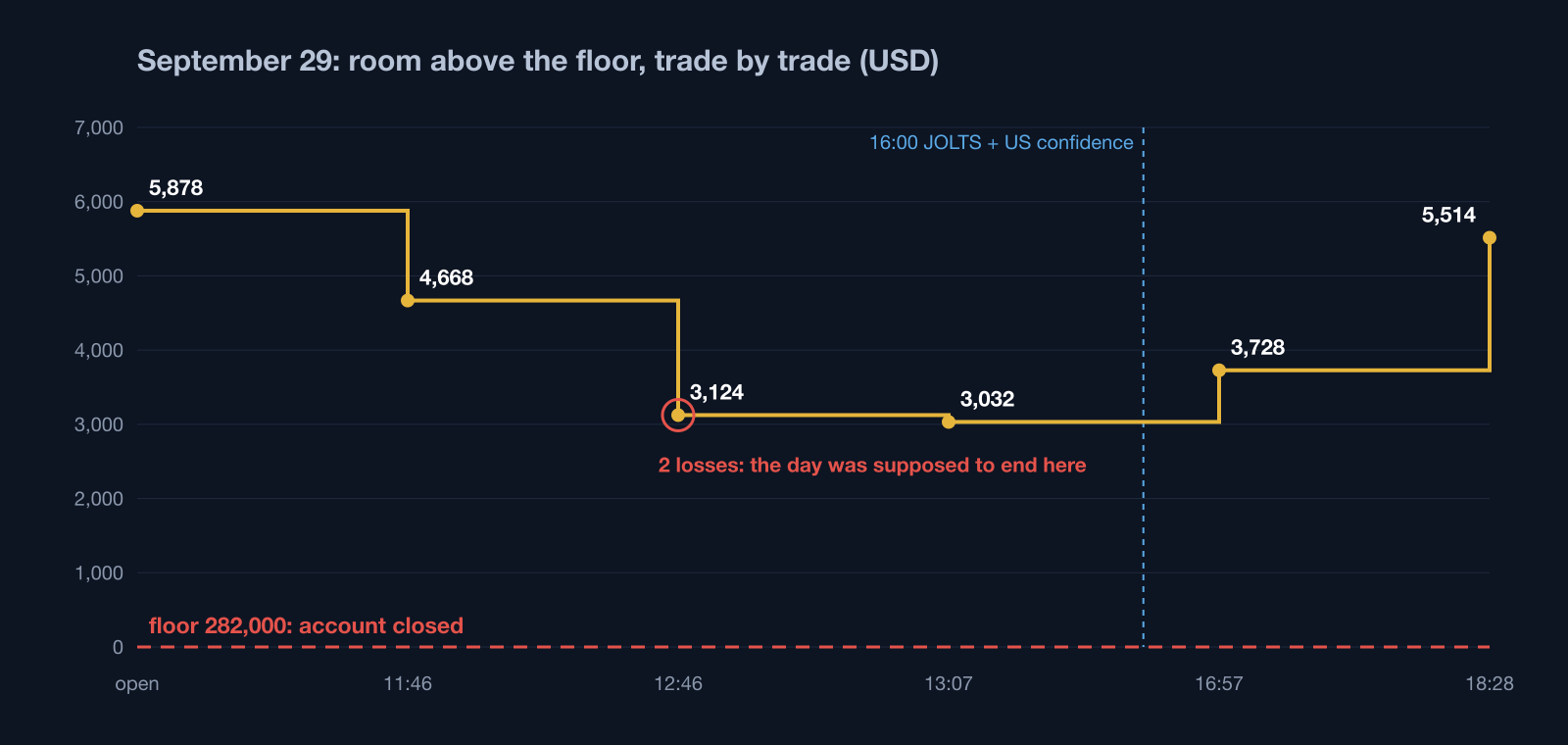
What I take from it, without dressing it up:
- I sold in the morning into a market that was climbing. Selling had worked all day Monday; on Tuesday the market had turned. The first two losses cost $2,754.
- The "2 losses and I'm done" rule broke again. At 12:46 I had my two losses. I took three more trades. They made money overall, which makes the mistake harder to see, not smaller.
- My $375 risk cap held on none of the trades. At 2 lots, every dollar gold moves is worth $200. A $375 stop would sit less than $2 away, too tight for gold. The real fix is a smaller size, not a tighter stop.
- No order went in with its stop attached. Stops were added afterwards. That is within the firm's 5-minute window, but not within my own rule.
One thing did work: no trade around 16:00. My first trade after the data came 51 minutes later, once the move was under way.
Paper trading: still far too few trades
The previous-day high/low breakout gave no signal on Tuesday: gold stayed between Monday's low ($4,110.89) and high ($4,275.11). Record unchanged: 4 trades, 1 winner, +$1,399.
The TRADE CRAFT signal channel, which I follow on paper with my own position size, sold at $4,152.87 at 17:26 and hit its target at 18:44: +$598. Record: 11 trades, 55% winners, −$2,082. Neither strategy has enough trades to judge. That takes about a hundred.
How to trade news on a prop firm account
Watch the gap between actual and forecast rather than the impact rating, and cut your size before looking for the right trade. What September 29 showed me:
- A "high" but expected release (the RBA) can produce a brief move that does not hold.
- Two "medium" releases surprising in the same direction (confidence and JOLTS) can make the real move of the day.
- Prop firm news trading rules often cover only "high" releases. On my account, no trade is allowed 10 minutes before or after a high-impact release, pending orders included (all 7 rules in episode 2). The 16:00 releases were not covered. Check your own firm's contract.
- Close to the floor, position size matters more than trade selection. Two stops at 2 lots cost me $2,754, almost half my room.
So I don't miss those windows, my script reads the Forex Calendar Pro economic calendar API (my own service) every morning, with the impact, forecast and actual for each release.
FAQ
Did the RBA raise rates on September 29, 2026?
Yes. The Reserve Bank of Australia lifted its cash rate from 4.35% to 4.60%, exactly in line with the consensus. AUD/USD gained 12.9 pips in the following minute and 11.3 pips after an hour, but the pair ended the day about 30 pips lower, from 0.7017 to 0.6987.
What did the JOLTS report do to gold on September 29, 2026?
It added to a rebound already under way. JOLTS job openings came in at 7.08 million against 7.23 million expected, released at the same time as a weak consumer confidence reading (81.9 vs 89.2). Gold gained $6 in one minute and $12.90 in one hour, and closed the day about $63 higher.
Does a high-impact release always move the market?
No. If the actual matches the forecast, the market has already priced it in. On September 29, the RBA hike, a "high" but expected release, produced only a short-lived move. Canada's GDP, also in line, moved USD/CAD by 0.7 pips. What moves price is the surprise.
Can you trade news on a prop firm account?
It depends on the contract. Many prop firms ban opening or closing a position within 10 minutes before and after a high-impact release, including pending orders triggered inside that window. On my account, the rule only covers "high" releases. Read your firm's exact wording before trading around the calendar.
Why cut position size instead of tightening the stop on gold?
Because a very tight stop on gold gets hit by ordinary noise. At 2 lots, each dollar of movement is worth $200, so risking only $375 would mean a stop less than $2 from entry. With a smaller size, the stop can sit at a sensible distance without exceeding the risk you set.
Previous episode: revenge trading saved my day, and that is the problem. All episodes of the journal are collected on the blog.
This article is not investment advice. Trading on margin carries a high risk of losing capital.
This content reflects personal experience and is not financial advice. Trading leveraged products carries a high risk of losing money.
Never get caught by a news spike again
Get every high-impact economic event in real time via API or Telegram.
See pricing