LLM Trading on Gold: Jev vs Claude vs Plain Python in MT5
LLM trading test on gold: I plugged Jev, Claude and a plain Python script into my MT5 indicator. Same data, same scoring rules, and the first zones compared.
Jev picks the sell and buy zones on gold in about one second, for less than a tenth of a cent, where Claude takes two and a half minutes and 4 cents. Jev is a new kind of AI model, still barely used in trading: it writes nothing, it judges. I plugged it into my MetaTrader 5 indicator, AI Zones, in place of Claude.
To find out whether it matches the original, and whether LLM trading beats plain algorithmic trading, I am running three versions side by side: Jev, Claude, and a pure Python version with no AI. Below you will see how Jev works, why I wanted to replace Claude, the three engines compared, their zones on Friday evening, September 25, the rules of the match and the custom indicator offer.
Key facts
- Jev (TypeSafe AI, available through Vercel AI Gateway) does not write text: it answers closed questions with choices, scores and probabilities.
- On gold, Jev answers 35 questions in a single call, in about one second, for under $0.001 per analysis, versus about 145 seconds and $0.04 for Claude.
- Three engines run on the same data: Claude writes everything, Jev judges zones prepared by Python, and Python alone applies fixed rules as the control.
- On September 25 at 20:10, all three suggested a sell under the previous day's high (4,303.26); Jev set the lowest stop (4,307.5 versus 4,312 and 4,318).
- None of the three has proven it makes money yet: the verdict needs several dozen finished zones per engine.
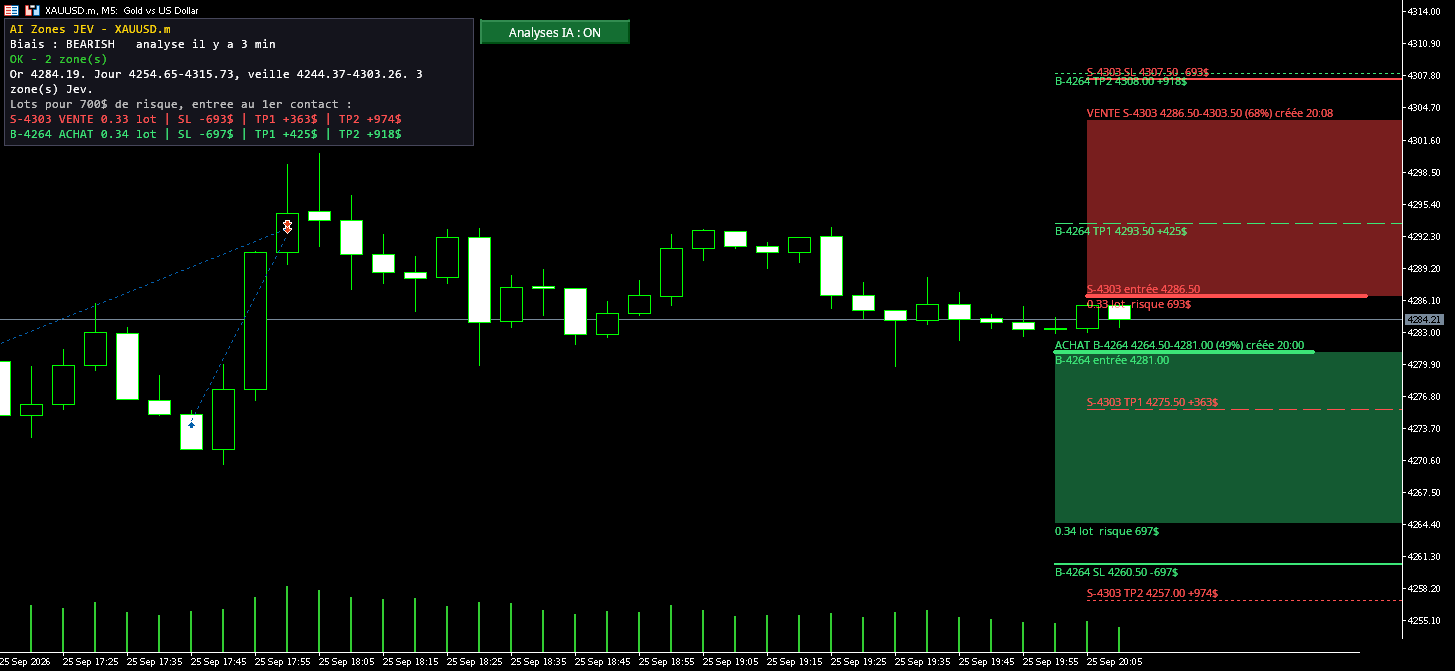
AI Zones running on Jev, Friday evening, September 25 (XAUUSD, 5-minute chart). Each rectangle starts at the time the zone was created, and its title says so ("créée 20:08"). The chart labels are in French.
Jev, a model that judges instead of writing
Jev does not write an answer: it receives a state and a list of closed questions, then answers each one with a probability. Most AI models we know write: you ask a question, they draft a reply. Jev, released by TypeSafe AI and available through Vercel's AI Gateway, works differently.
Here, the state is everything known about the gold market at that moment. The answers look like this: 94% yes, option A at 51%, a score of 1.6 out of 3. Those are its real answers from my first test.
- 35 questions asked in a single call, seven per candidate zone.
- About 1 second for all the answers, versus two and a half minutes for Claude.
- Under $0.001 per analysis, roughly forty times cheaper than Claude.
This way of answering changes everything for an indicator. Each of Jev's decisions comes with its degree of certainty, and Jev even returns its own confidence, question by question. And since it costs almost nothing, I can ask for a fresh opinion every 5 minutes instead of every 15.
Why replace Claude with Python and a deciding model
Claude's zones all rested on levels a program can compute on its own, so the AI's real job is judgment. The first version of AI Zones sends the gold candles and the economic calendar to Claude every 15 minutes, and Claude answers with its sell and buy zones, their stops and their targets. It works well, but each analysis takes about two and a half minutes and costs 4 cents.
Rereading its answers, I noticed something simple. The six distinct zones Claude suggested during the day were all built on levels a program computes by itself: high and low of the day, of the previous day, peaks and troughs of the 15-minute candles. Each time within $3. Its stops sat just behind the next level, its targets just before the opposite level.
In other words, Python can produce the numbers. What Claude really brings is judgment: which level is worth it, which stop to pick. That is exactly where Jev comes in.
LLM trading vs algorithmic trading: the three engines
All three engines read the same gold data; only the way they decide changes. Claude decides everything, Jev chooses between options prepared by Python, and Python alone applies fixed rules with no AI: that is algorithmic trading in the strict sense, and it serves as the control.
| Engine | Role | Time | Cost per analysis | Frequency |
|---|---|---|---|---|
| Claude | Reads the candles and writes everything: zones, stops, targets, comment | ~145 s | ~$0.04 | 15 min |
| Jev | Python proposes the priced zones, Jev judges each criterion and picks the stop and target | 1 to 5 s | < $0.001 | 5 min |
| Python only | Same candidate zones, same criteria, settled by fixed rules | instant | $0 | 5 min |
How Jev makes its decisions
Jev cannot write a price, so Python prepares everything and asks it closed questions. Python computes the levels of the day, the previous day and the week, the candidate zones with their number of touches, the wick length at the last contact, the trend, upcoming releases, three possible stops and the possible targets. Then, for each zone, it asks seven questions in a single call:
- Is the level important (day, previous day, week, shelf)? Yes or no.
- Does the trade go with the trend? Yes or no.
- Did price clearly reject this level? Yes or no.
- Does the first target pay at least the risk? Yes or no.
- Which stop: A (tight), B (behind the next level) or C (wide)?
- Which first target among the proposed levels?
- What quality, from "avoid" to "excellent"?
With 5 candidate zones, that is 35 questions, handled in about one second. Python then assembles the answers into zones, calculates the lot sizes and writes the same file as Claude. The indicator cannot tell the difference.
Round one on gold, Friday evening
On September 25 at 20:10 (MT5 time), with gold at 4,284, all three engines suggested a sell under the previous day's high, but not with the same stops. Here are each engine's zones:
| Engine | Zone | Range | SL | TP1 | Confidence |
|---|---|---|---|---|---|
| Claude | sell S1 | 4,296.0-4,308.0 | 4,318.0 | 4,276.0 | 62% |
| Claude | buy B1 | 4,255.0-4,266.0 | 4,242.0 | 4,282.0 | 55% |
| Jev | sell S-4303 | 4,286.5-4,303.5 | 4,307.5 | 4,275.5 | 68% |
| Jev | buy B-4264 | 4,264.5-4,281.0 | 4,260.5 | 4,293.5 | 49% |
| Python | sell S-4303 | 4,296.0-4,303.5 | 4,312.0 | 4,275.5 | 80% |
| Python | buy B-4255 | 4,254.5-4,261.5 | 4,242.0 | 4,286.5 | 80% |
| Python | sell S-4316 | 4,309.0-4,315.5 | 4,324.0 | 4,275.5 | 80% |
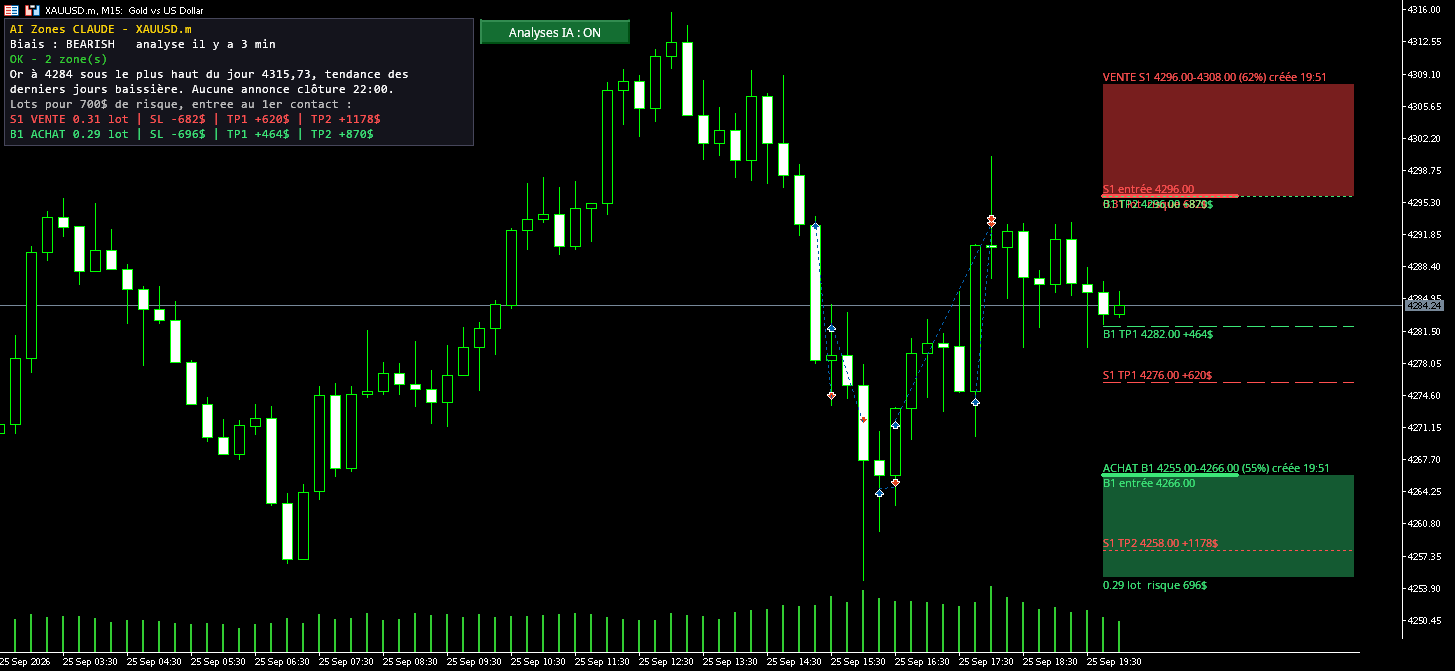
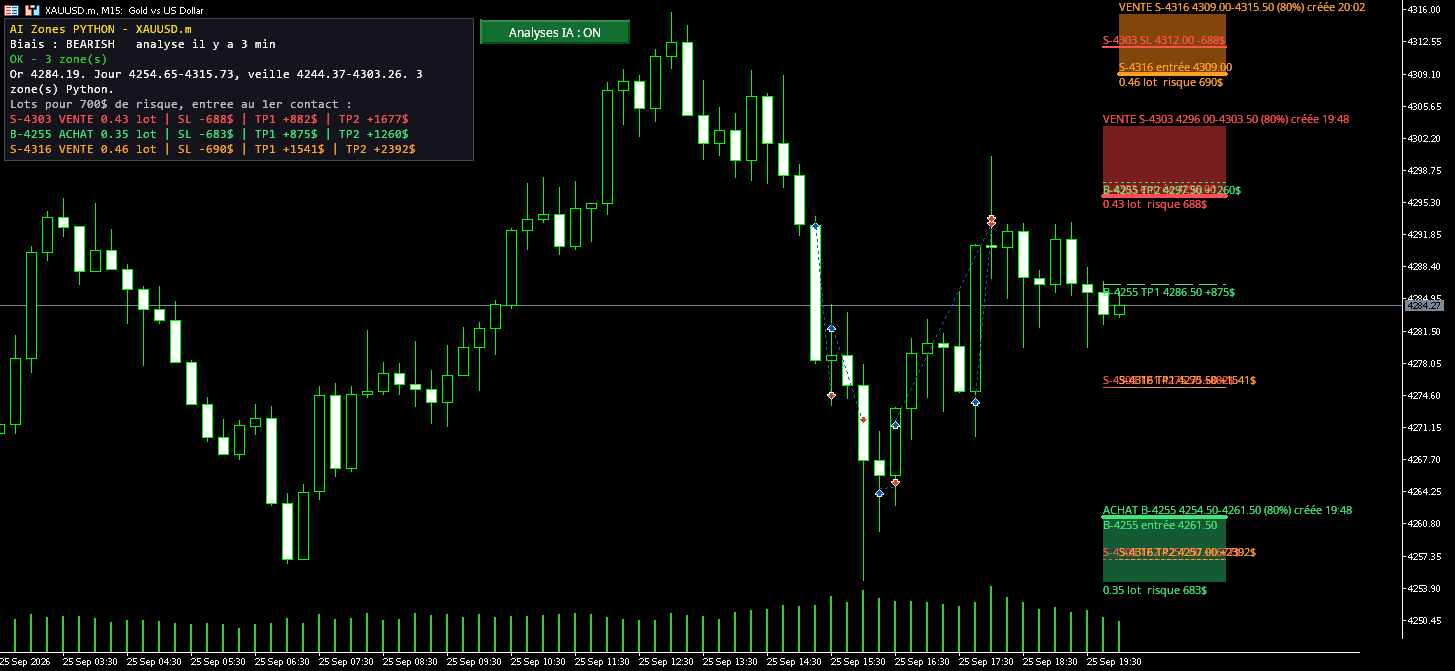
Claude's chart (top) and Python's chart (bottom), at the same moment and on the same instrument as Jev's chart above (15-minute charts).
The three engines agree on the essentials: a sell under the previous day's high (4,303.26), in a downtrend. They differ on the details. Jev puts its stop closest to the previous day's high: 4,307.5, versus 4,312 for Python and 4,318 for Claude. But its sell zone starts lower (4,286.5): at first contact it risks 21 points, versus 16 for Python and 22 for Claude. For the same $700 risk, that gives 0.33 lot, versus 0.43 and 0.31 according to the chart panels. Python is the most generous with zones, Jev and Claude more selective.
The percentages cannot be compared across engines. Claude's is its judgment, Jev's combines its probabilities and its score, Python's is the share of criteria met.
The rules of the match and what I am watching
All three engines are judged exactly the same way, on real one-minute candles, with a score in R. To keep the match fair:
- A zone only counts if price comes to it after it was created. On the chart, an arrow marks that moment: "entrée 20:15".
- Then, which comes first: the TP1 target (green check) or the stop (red cross). If both are hit in the same minute, I count the stop.
- The score is in R: a stop is worth −1, a TP1 is worth the gain divided by the risk. A zone with a distant target that succeeds earns more than a zone with a close target.
- Zones stay stable. A zone does not change its numbers from one analysis to the next; it only disappears if its stop or target was hit after entry, or if it no longer meets the criteria.
The scoreboard updates itself with each analysis. It will take several dozen finished zones per engine before concluding anything: the first review will come once that threshold is reached.
What I am already watching
Three things stand out from the first evening: Jev's reliability, its hesitations, and the score of the no-AI control.
- Jev's reliability. On the very first evening, it answered "service temporarily unavailable" three times. When that happens, its chart does not update for 5 minutes. Claude had no outages.
- Its hesitations. On a test zone, Jev picked its stop at 51% versus 49%, close to a coin flip. Fortunately it returns its own confidence for each answer, which will let me set aside its least certain answers.
- The control. If the Python version, free and without AI, does as well as Jev, that is the one to keep. The AI has to prove it adds something.
None of these three engines has proven it makes money on gold yet. These zones tell me where to watch price, not what to do blindly. This comparison exists precisely to measure that, with numbers.
A custom MT5 indicator with the AI of your choice
I build this kind of tool as a freelancer, for around €500. If you trade on MetaTrader 5 and want an indicator that draws your zones with an AI like Jev or Claude, or with fixed rules, I can build it for you, on your instruments and with your rules.
| Item | Detail |
|---|---|
| Platform | MetaTrader 5 |
| Engine | Jev, Claude or fixed rules |
| Instruments | yours |
| Installation | included |
| Price | around €500 |
What is included:
- sell and buy zones, stop and targets;
- lot sizes calculated for the risk you choose;
- creation time and entry, TP and SL markers;
- a button to stop or restart the analysis.
It is a decision-support tool: it displays zones, places no orders and promises no gains. To discuss it, email me at wdltradingapi@gmail.com. If you want to add economic releases to your indicator, my Forex Calendar Pro economic calendar provides them through an API.
FAQ
What is Jev, TypeSafe AI's model?
Jev is a decision model released by TypeSafe AI and available through Vercel AI Gateway. Instead of writing text, it evaluates a supplied state against typed questions and returns choices, scores and probabilities. Several questions go through in one call: for my gold indicator, 35 questions in about one second.
Is an LLM better than fixed trading rules?
I do not know yet, and that is what the test is for. Claude, Jev and a Python version with no AI run on the same gold data, with the same R-based scoring rules. If the fixed rules do as well as Jev, for free, those are the ones I will keep. The verdict needs several dozen finished zones per engine.
Claude or Jev: which AI should you use for a trading indicator?
On speed and cost, Jev wins clearly: about one second and under $0.001 per analysis, versus 145 seconds and $0.04 for Claude. On reliability, Claude leads: Jev was unavailable three times on the first evening. On zone quality, nothing has been measured yet.
How do you compare trading engines fairly?
By judging them all the same way on real one-minute candles. In my test, a zone only counts if price comes to it after it was created, then I check which comes first between TP1 and the stop. A stop is worth −1 R, a TP1 is worth the gain divided by the risk, and a tie within the same minute counts as a stop.
How much does a custom MT5 indicator cost?
Around €500, installation included, for a MetaTrader 5 indicator that draws your sell and buy zones with Jev, Claude or fixed rules, on your instruments. It calculates lot sizes for the risk you choose and shows stops and targets. It places no orders and guarantees no gains.
All the journal's articles are collected on the blog.
This article is not investment advice. Trading on margin carries a high risk of losing capital.
This content reflects personal experience and is not financial advice. Trading leveraged products carries a high risk of losing money.
Never get caught by a news spike again
Get every high-impact economic event in real time via API or Telegram.
See pricing